According to an estimate nearly 2 billion individuals, surpassing the combined populations of India, the US, and Brazil, are estimated to be affected by myopia, commonly known as short-sightedness and this figure will likely reach 3.3 billion – about half of the world’s population by 2050. It’s clear that our vision is becoming increasingly blurry, but we are only now getting to know why.
You know how sometimes kids end up needing glasses because they can’t see things far away? Well, that’s often because their eyeballs grow too long instead of staying round. Normally, our eyes have a built-in signal to grow just right along with the rest of our head. But sometimes, things like genetics or the environment can mess with that signal, causing our eyeballs to grow a bit too much. And when they get too big, it’s like they’re outgrowing the lenses and the cornea, which are supposed to focus our vision.
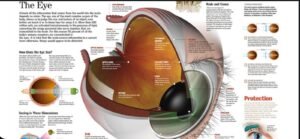
When your eyeballs grow too big for their own good, it’s like they’re not playing nice with the lenses and cornea anymore. So, when you try to look at stuff far away, it’s all blurry and out of focus. And that’s not the only trouble it causes! If you find yourself getting headaches a lot or feeling super tired when you’re driving or playing sports, it could be a sign that your eyes are working extra hard to focus properly.
We tend to point fingers at screens when it comes to eye problems, but it’s not exactly the screen’s fault. It’s more about what we’re not doing enough of: spending time outdoors. Turns out, natural light is like vitamins for our eyes.
There’s this study that found when kids and young adults soak up more sunlight, especially the UVB rays, their chances of getting myopia go down. So, maybe it’s time to step outside and give those eyes a healthy dose of sunshine!
Think of natural light as a boost of happy juice for your eyes. It’s like a shot of dopamine that helps them grow and develop properly. But here’s the catch: indoor lighting doesn’t quite cut it. So, to keep those peepers in top shape, it’s recommended that kids soak up at least two hours of sunshine each day. Time to schedule some outdoor adventures!
Our increased use of screen is also a problem. Most screens are high contrast like black text on a white page, or light text on a dark background. It is still a theory but some scientists believe that the contrast of reading a book or looking at a bright screen in a dark room might be over-stimulating our retinas, causing more eye growth in children.
Scientists are working on ways to slow down rising myopia rates. A study found out that eyedrops with a low dose of atropine can slow down myopia in kids. There is also some early evidence that a type of contact lenses called peripheral defocus lenses might stop near sightedness from worsening.
Most people’s vision will stabilize in their teens, but some people develop myopia later in life, mostly between ages 25-40. Blurry vision is not the only worrying part; One can also reduce eye strain by making simple lifestyle changes such as, reading or working in good light, plus following 20-20- 20 rule.
When we spend time looking at the screen, our blink rate decreases from 18 times per minute to 6-8 times per minute. This causes dry eye and irritation. Myopia is set to increase many fold in the coming years and it is up to us to ensure one day in a week as a no gadget day or minimum gadget day and find happiness and containment in things we used to enjoy when we were kids without the gadgets.